NDIS Service Agreement Template
Set out the supports you will deliver and the terms both sides agree to. This NDIS service agreement covers responsibilities, payment via the NDIA, a plan manager or self-management, cancellations and how either party can end the arrangement.
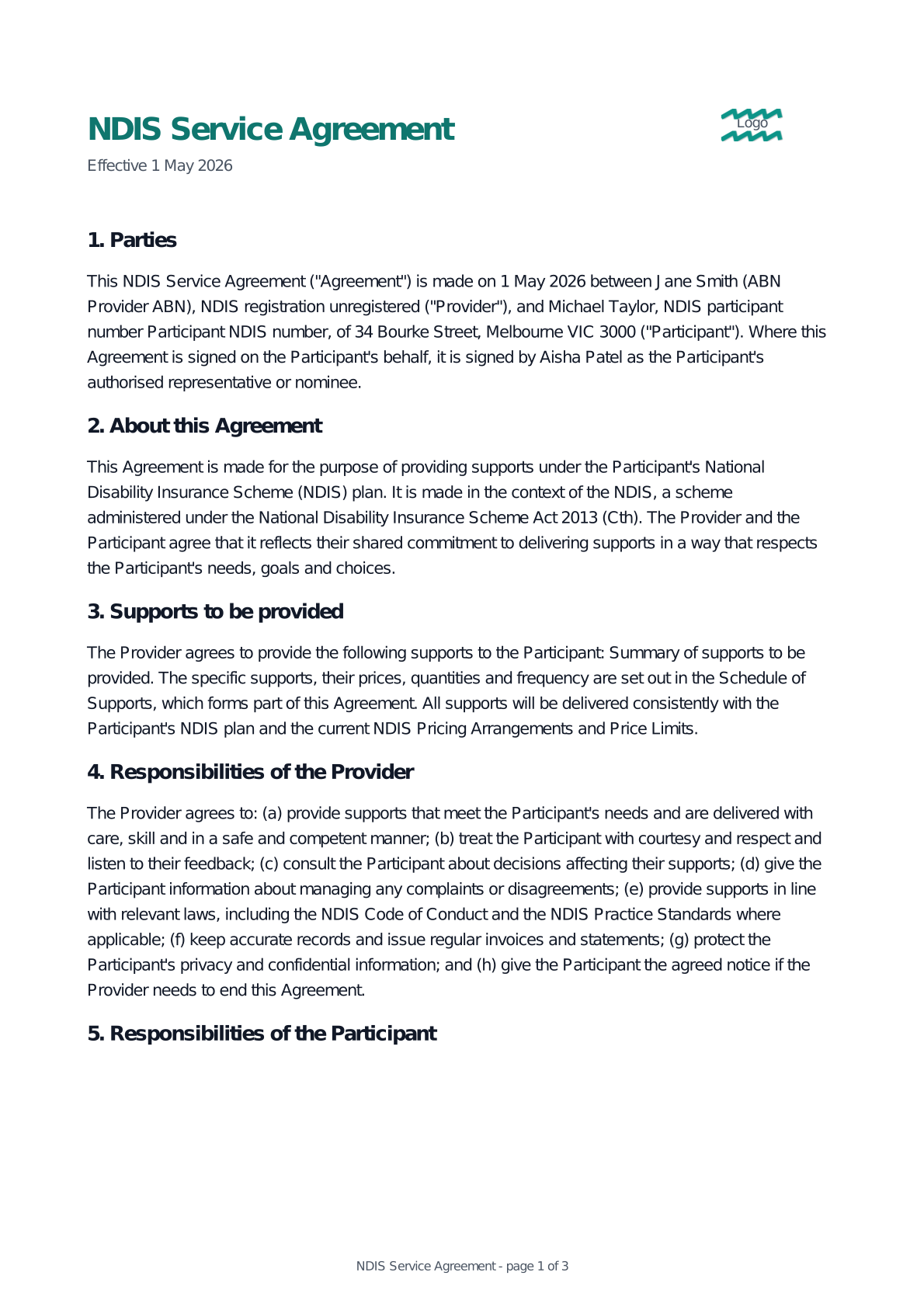
What's in this template
The NDIS Service Agreement covers the sections below. Each is pre-written and editable, with signing fields already placed for every party.
- Parties
- About this Agreement
- Supports to be provided
- Responsibilities of the Provider
- Responsibilities of the Participant
- Payment for supports
- Cancellations
- Changes to this Agreement
- Term and ending this Agreement
- Feedback, complaints and disputes
- General
Who signs & who it's for
Signing parties (in order):
- 1Provider
- 2Participant / Representative
Commonly used by:
- Registered and unregistered NDIS providers
- Support coordinators onboarding a participant
- Allied health and disability support services
A starting point, not legal advice
Do you need a written NDIS service agreement?
A service agreement records what a provider and a participant have agreed about the participant's NDIS supports. It is separate from the participant's NDIS plan, and it is not the same as a service booking or a tenancy agreement.
Whether you need one depends on the support. According to the NDIS, participants must have a service agreement with their Specialist Disability Accommodation (SDA) providers, and service agreements are encouraged for Supported Independent Living (SIL) providers. For other supports a written agreement is not required, but the NDIS recommends making one when a participant starts working with a new provider or when their needs change. In practice most providers use one with every participant, because it gives both sides a shared understanding of rights and responsibilities and a clear process if something goes wrong.
The NDIA and the NDIS Quality and Safeguards Commission are not parties to service agreements, do not keep records of them and cannot enforce what is in them. The agreement is between the provider and the participant (or their representative), so each of you should keep a signed copy. The NDIA has also published its own optional service agreement template with the NDIS Commission - you can use whichever suits you, as long as it covers what both parties need.
What to include in an NDIS service agreement
The NDIS suggests a good service agreement covers who it is for, which supports are provided and how, what they cost, how the provider gets paid, important dates and reviews, both parties' rights and responsibilities, and what to do if you disagree or something goes wrong. This template is laid out around those points:
Parties and supports - the provider's name, ABN and NDIS registration (or "unregistered"), the participant's name and NDIS number, any representative signing on their behalf, and a summary of the supports. The detailed supports, prices, quantities and frequency go in a Schedule of Supports that forms part of the agreement.
Responsibilities - what the provider commits to (safe, competent supports, respect, consultation, records and regular invoices, the NDIS Code of Conduct and, where applicable, the NDIS Practice Standards) and what the participant commits to (how they want supports delivered, giving notice of changes, telling the provider if their plan changes).
Payment, cancellations, changes and ending the agreement - how the plan is managed and who pays, the cancellation notice period and short notice cancellation fees, how changes are agreed in writing, the agreement's start and end dates, and how either party can end it.
Feedback, complaints and disputes - how the participant can raise a concern with you, and the NDIS Quality and Safeguards Commission's contact details if it is not resolved.
For support prices and cancellation rules, check the current NDIS Pricing Arrangements and Price Limits when you fill in the schedule - they are updated regularly, so this template refers to them rather than quoting any amounts.
NDIA-managed, plan-managed and self-managed participants
A participant's funding can be managed in three ways, and it can be a mix across support categories. The payment clause in this template has a field for how the plan is managed, and the way you get paid follows from it:
NDIA-managed (also called Agency-managed) - the NDIA pays providers, so you claim payment from the NDIA after the supports are delivered.
Plan-managed - a registered plan manager pays providers and keeps the financial records, so you send your invoices to the participant's plan manager. Record the plan manager in the agreement so invoices go to the right place. Note this template is an agreement between a provider and a participant; it is not a plan manager's own engagement agreement with the participant.
Self-managed - the participant, their nominee or representative pays providers directly, so you invoice them.
Allied health providers and sole traders
The same agreement works for allied health services such as physiotherapy, occupational therapy and speech pathology, and for disability support workers who operate as sole traders. Describe your therapy or support in the supports summary and the Schedule of Supports, and set a cancellation notice period that suits your appointments.
You do not need to be a registered NDIS provider to use it. The parties clause has a field for your NDIS registration number, or you can enter "unregistered".
Signing an NDIS service agreement electronically
Agreements signed electronically through AirSign are supported by the Electronic Transactions Act 1999 (Cth) and equivalent state and territory legislation. You send the agreement by email, and the participant or their representative reviews and signs in their browser on a phone, tablet or computer - they do not need an AirSign account. Every party gets the completed document, with an audit trail attached to every signature, which also helps when you need to show signed records at an audit.
This page is general information only, not legal or financial advice. NDIS rules change, so check the official NDIS guidance and get advice for your own situation before you rely on any agreement.
How to send a NDIS Service Agreement for signing
Pick the template
Start from this template in AirSign. The document, signing fields and signer roles are already laid out for you.
Fill in your details
Enter names, dates and the other details as guided fields. Tweak any wording in the editor if you need to.
Send for signing
Send it to each party by email. They sign securely in the browser and everyone gets the completed, audit-trailed document.
NDIS Service Agreement - Frequently Asked Questions
Do I have to be a registered NDIS provider to use this?
No. The agreement works for both registered and unregistered providers - there is a field for your NDIS registration number, or you can mark yourself as unregistered. Registered providers also need to meet the NDIS Practice Standards, which this agreement references.
Does it cover NDIA-managed, plan-managed and self-managed participants?
Yes. The payment clause has a field for how the plan is managed and explains that the provider claims from the NDIA, the plan manager, or invoices the participant directly, depending on which applies.
Is an NDIS service agreement mandatory?
Only for some supports. The NDIS says participants must have a service agreement with their Specialist Disability Accommodation (SDA) providers, and service agreements are encouraged for Supported Independent Living (SIL) providers. For other supports one is not required, but the NDIS recommends making one when a participant starts with a new provider or their needs change.
Is this template legally binding in Australia?
When signed electronically through AirSign, agreements made with this template are supported by the Electronic Transactions Act 1999 (Cth) and equivalent state and territory legislation, with a complete audit trail attached to every signature. The wording is an Australian-aligned starting point - for important matters, have it reviewed by a qualified professional.
Can I customise the template before sending it?
Yes. Every field is a fillable variable - names, dates, amounts and other details are entered when you start, and the rest of the wording can be edited in the AirSign editor to suit your situation before you send.
Do the people signing need an AirSign account?
No. Signers receive a secure link by email and can review and sign in their browser - no account, app or installation required. Only the person sending the document needs an AirSign account.
Is it really free to start?
You can start from any template on the AirSign free trial with no credit card required. Browse the wording here, then create your account to fill it in and send it for signing.
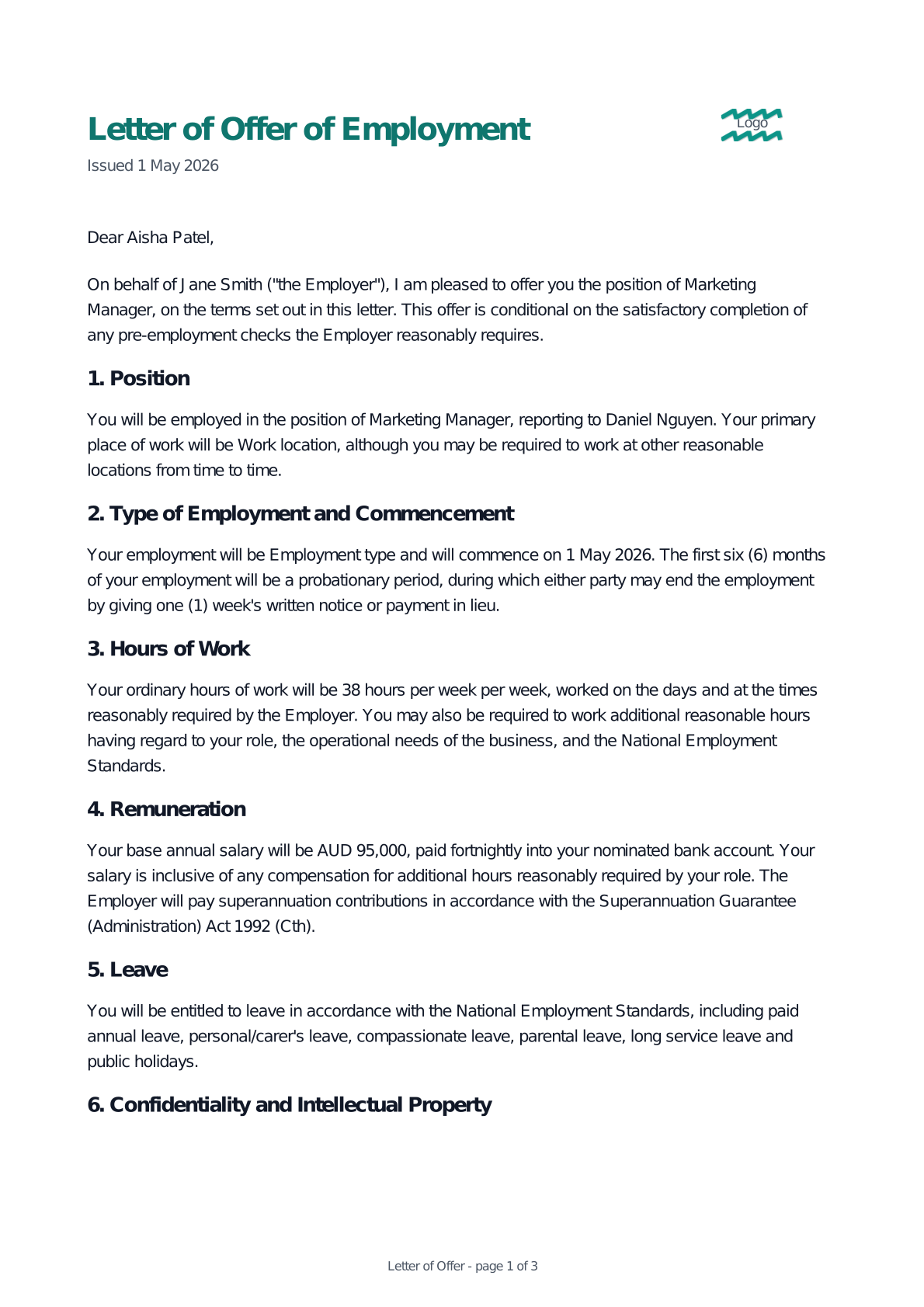
Ready to send your NDIS Service Agreement?
Fill in this template with your details and send it for legally binding e-signing. Try AirSign free - no credit card required.